Over the past nine guides, we’ve walked through the complete field testing workflow, from obtaining a representative concrete sample through measuring temperature, slump, air content, unit weight, and properly casting and curing strength specimens.
Every one of those steps generates critical information. But field testing isn’t complete until that information is accurately documented, connected to the appropriate samples and specimens, and made available for reporting.
Accurate reporting doesn’t simply satisfy project requirements, it establishes traceability. It provides the documentation owners, engineers, contractors, and testing laboratories rely on to demonstrate that concrete testing was performed in accordance with applicable standards.
ASTM References
- ASTM C31/C31M
- ASTM C172/C172M
- ASTM C1064/C1064M
- ASTM C143/C143M
- ASTM C231/C231M
- ASTM C173/C173M
- ASTM C138/C138M
- ASTM C1077
Field Data Doesn’t Exist in Isolation
By the time a technician leaves the jobsite, they’ve likely recorded:
- Project and placement information
- Sample identification
- Batch ticket information
- Concrete temperature
- Slump
- Air content
- Unit weight
- Cylinder identification
- Initial curing conditions
- Weather observations
- Photographs
- Notes regarding unusual conditions
None of these data points are particularly valuable by themselves.
Their value comes from being connected to a specific concrete sample and remaining connected throughout the entire testing lifecycle.
The cylinders cast in the field eventually become compression tests in the laboratory. Those laboratory results only tell the complete story when they remain tied back to the field data collected when the concrete was placed.
ASTM C1077 and Traceability
ASTM C1077 establishes the quality management requirements for agencies performing concrete testing.
Among other requirements, testing agencies must maintain complete documentation, demonstrate technician competency, retain test records, and produce reports containing project, sample, and client information.
Meeting those requirements depends on more than simply performing the required tests correctly. It also requires maintaining a complete, traceable record from field sampling through laboratory testing and final reporting.
Paper records, handwritten notes, spreadsheets, and disconnected systems all create opportunities for information to become separated from the samples they describe.
The Challenge with Traditional Workflows
Many laboratories still rely on paper field cards, handwritten notes, spreadsheets, and manual data entry.
Every additional step introduces another opportunity for error.
A technician may perform several tests while simultaneously casting cylinders. Later, those handwritten notes must be interpreted, entered into another system, matched with the correct specimens, and eventually combined with laboratory test results.
Even in well-managed laboratories, this creates unnecessary work and increases the potential for:
- Missing or incomplete documentation
- Transcription errors
- Duplicate data entry
- Delayed reporting
- Difficulty locating historical records
- Inconsistent sample identification
The more times information is handled, the greater the opportunity for mistakes.
Connecting the Field to the Lab
This is where digital field data collection fundamentally changes the workflow.
Rather than recording information on paper for later entry, technicians can capture field data directly as testing is performed.
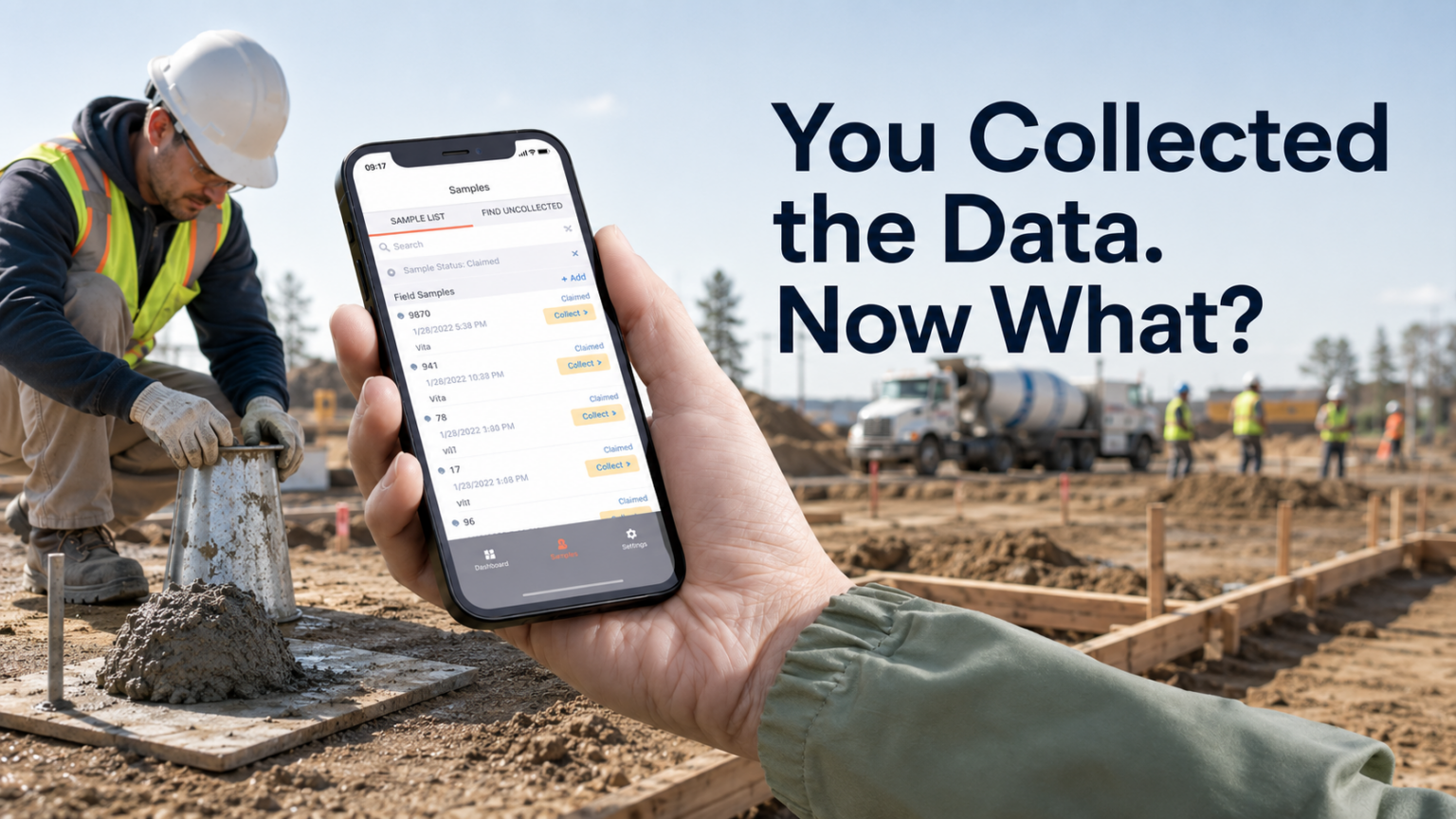
With ForneyField, every measurement collected throughout this series, including sample information, temperature, slump, air content, unit weight, specimen identification, photographs, and field observations, is organized around a single concrete sample while the technician is still on the jobsite.
That information is immediately synchronized with ForneyVault, eliminating the need to manually recreate the same information once the cylinders arrive at the laboratory.
When those cylinders are later tested on a ForneyVault-compatible compression machine, the strength results automatically return to the same sample record.
The result is a single, continuous chain of information that begins with fresh concrete sampling and ends with completed laboratory testing and client reporting.
Reporting Without Rebuilding the Story
Because every field measurement and laboratory result remains connected throughout the workflow, reports become a natural output rather than another manual process.
Instead of gathering information from clipboards, spreadsheets, photographs, emails, and testing equipment, ForneyVault automatically assembles the complete testing record.
Whether producing:
- Field reports
- Sample reports
- Cylinder break reports
- Placement reports
- Acceptance documentation
- Historical project records
The information is already organized, searchable, and available for review.
Technicians spend less time entering data and more time performing tests.
Laboratories spend less time assembling reports and more time serving their clients.
Forney Fact
The most valuable piece of field data isn’t temperature, slump, air content, or unit weight, it’s the connection between all of them.
When every field measurement, specimen, image, and laboratory result stays connected from the moment the sample is collected through final reporting, the entire testing process becomes more accurate, more efficient, and significantly easier to audit.
Completing the Workflow
From collecting a representative sample through reporting final compressive strength results, every step in the concrete testing process depends on the integrity of the one before it.
This series has explored each of those field testing steps individually. When performed consistently, and supported by connected digital workflows, they become a complete, traceable record of concrete quality from placement through final acceptance.
Checkout https://forneyvault.com/ to learn more.