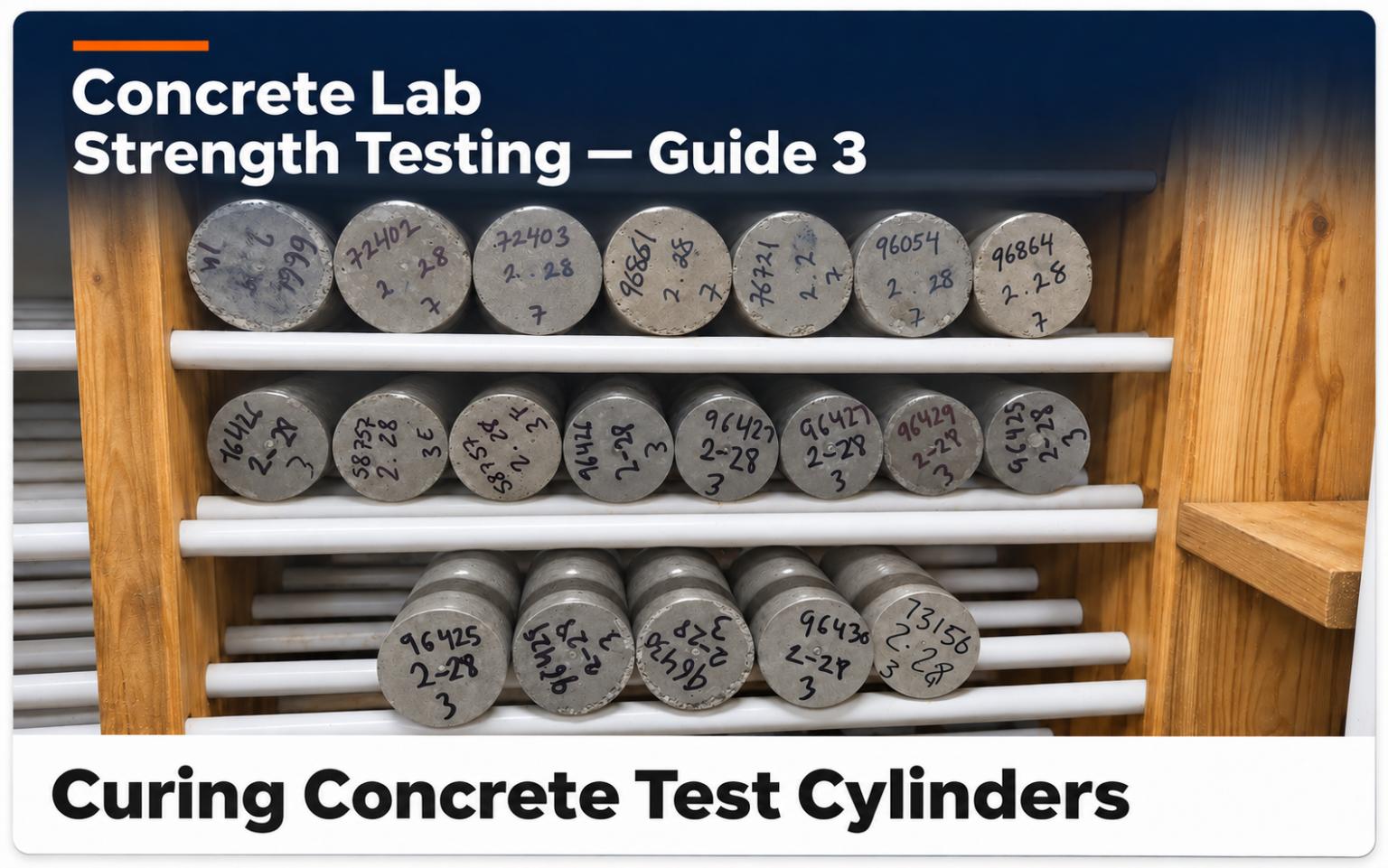
Guide 2 followed specimens from the demolding bench into final curing. This guide covers the days or weeks they spend in a moist room, moist cabinet or water storage tank before testing.
Controlled curing allows test cylinders to develop strength under standardized conditions, providing a consistent basis for evaluating the concrete delivered to a project. Improper temperature or moisture conditions can compromise that basis, and no compression machine can compensate for improper curing.
Like Guides 1 and 2, this guide focuses on standard-cured concrete cylinders. Specimens designated for field curing require handling consistent with their intended purpose and the applicable procedures.
ASTM References
- ASTM C31/C31M — Making and curing concrete test specimens in the field, including final curing conditions.
- ASTM C511 — Requirements for moist cabinets, moist rooms and water storage tanks used for curing.
- ASTM C1077 — Requirements for concrete testing agencies, personnel, equipment and records.
Use the standards editions required by the project and the laboratory’s approved procedures.
Materials Required
- Moist room, moist cabinet or water storage tank (meeting ASTM C511)
- Temperature recorder or recording system appropriate to the curing facility and tank arrangement
- Reference temperature device with documentation verifying its accuracy
- High-calcium hydrated lime (for tanks)
- Level shelving or racks
- Curing logs or digital records
Choose the Right Curing Facility
 C31/C31M requires final curing at 73.5 ± 3.5°F (23.0 ± 2.0°C) with free water maintained on specimen surfaces, subject to its specific exceptions for sulfur mortar capping and immediately before testing. A suitable moist room, moist cabinet or water storage tank can provide the required curing conditions.
Moist rooms provide accessible shelf storage but require routine attention to spray distribution, nozzles and door seals. Tanks may have a lower initial cost, depending on capacity and installation, but require limewater maintenance and an organized system for locating specimens. Select the facility around the lab’s volume, available space and ability to maintain the required conditions. Provide heating, cooling or both, as needed.
Moist Rooms and Moist Cabinets
A moist cabinet provides enclosed storage, while a moist room is a walk-in space. Both must maintain the required temperature and moisture conditions.
- Temperature. Hold the air at 23.0 ± 2.0°C (73.5 ± 3.5°F), apart from times when loading or removing specimens.
- Humidity. Keep relative humidity at 95% or higher. Every exposed specimen surface should be visibly wet and damp to the touch.
- Control. Provide heating, cooling (or both) and keep recorder data showing the facility stays in range over time.
- No dripping or running water. Falling water can leach specimens and lower strength. A clogging nozzle often drips before it fails, so inspect nozzles routinely.
- Recording. Every moist room and cabinet needs its own temperature recorder.
Water Storage Tanks
- Temperature. Keep the water at 23.0 ± 2.0°C (73.5 ± 3.5°F), apart from the permitted interruptions for specimen handling and tank maintenance. Provide automatic temperature control when the surrounding room is not maintained within that range, or whenever the tank otherwise has difficulty maintaining the required temperature.
- Lime saturation. Saturate the water with high-calcium hydrated lime, with undissolved lime remaining in the tank. Ground limestone won’t prevent leaching.
- Maintenance. Mix each tank thoroughly at least monthly. At intervals no longer than 24 months, clean it and refill it with potable water containing 3 grams of calcium hydroxide per liter. Maintain excess lime to sustain saturation.
- No running fresh water. It strips calcium from specimens. A closed loop circulating saturated limewater between tanks is acceptable.
- Recording. A tank outside a moist room or cabinet generally needs a temperature recorder with its probe in the water. Interconnected tanks may share a recorder when tubing allows water to flow between all tanks, circulation is provided, and the temperature variation between tanks does not exceed 1.0°C when checked and recorded weekly.
Monitor and Verify Temperature
- Record. Use a recorder that captures temperatures at intervals of 15 minutes or less and is accurate and readable to 1°C.
- Review. Evaluate the data at least weekly. Record the period covered, review date, reviewer and whether temperatures met the required range. Identify any excursions and document the corrective action taken or planned.
- Verify. At least every six months, or whenever accuracy is questioned, compare the recorder with a reference device accurate and readable to 0.5°C. Perform the comparison in the operating curing facility, with the reference device near the recorder probe. For rooms or cabinets, keep the door closed for at least five minutes before taking readings. For tanks, allow readings to stabilize and read the reference device while it remains in the water. Record both readings and retain documentation verifying the reference device’s accuracy.
- Adjust. If the recorder and reference readings differ by more than 1°C, adjust the recorder to within 0.5°C of the reference and document the adjustment.
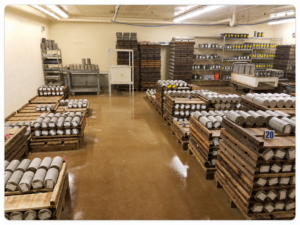 Data loggers simplify collection, but the records still need review. AASHTO re:source identifies missed weekly evaluations and temperature recorder standardization problems among common assessment findings.
For laboratories in the AASHTO Accreditation Program, the program’s curing-facility policy also requires the weekly review to be documented with the temperature data, recorder data to be retained for at least three years, and recorder standardization to be performed in place during normal facility operation. Follow the program’s reference-thermometer calibration requirements as well.
How Improper Curing Affects Results
Curing errors can go unnoticed because a cylinder may fracture normally and still produce a result affected by its curing history. Low temperatures can slow strength development. Elevated temperatures may increase early-age strength while reducing later-age strength; the effect depends on the temperature history, mixture and test age. Drying and leaching from dripping water or inadequately saturated tank water can also compromise results.
Unreliable results can complicate acceptance decisions, trigger investigations or additional testing, and delay project decisions. Standard-cured cylinder results provide a basis for evaluating concrete strength under standardized conditions; they do not directly measure the strength of concrete in the structure. An unresolved C511 nonconformance can also affect accreditation for related tests, depending on the accreditation program’s requirements.
Document
An out-of-range temperature, failed recorder, dripping nozzle or missed maintenance interval should trigger a documented review under the lab’s procedures. Record when the issue began or was discovered, its known duration and extent, and the observed conditions. Identify specimens potentially affected using their storage locations and dates. Document actions taken to restore conditions, who reviewed the issue and the authorized disposition, including any qualification needed on the report. An excursion requires evaluation; it does not automatically establish that every specimen is unusable.
Connect the Record
Keep the curing facility’s required temperature data, reviews and verification records together with its maintenance history. As recommended laboratory practices, also record each specimen’s curing start, storage location, transfers and removal for testing. These specimen tracking details help staff identify potentially affected cylinders when a facility issue occurs. Follow any additional project or laboratory requirements for these records.
With ForneyVault®, specimen records stay connected from field collection through lab testing and reporting. Barcode scans help staff confirm the correct specimen record. Recording curing events and storage locations against that identity, and retaining the associated facility records, helps connect the specimen’s curing history to its result.
Forney Fact
Collecting curing temperatures is only part of the job. The records also need a documented weekly review. A data logger can show what happened; reviewing that record helps the lab identify excursions and determine which specimens may have been affected.
Next in the Series
Guide 4, Limewater for Concrete Curing Tanks: Why It Matters and How to Maintain It, takes a closer look at preparing, replenishing and maintaining lime-saturated water for specimen storage.
Have a question about your lab’s workflow? Visit the Forney Knowledge Base or talk to our team.