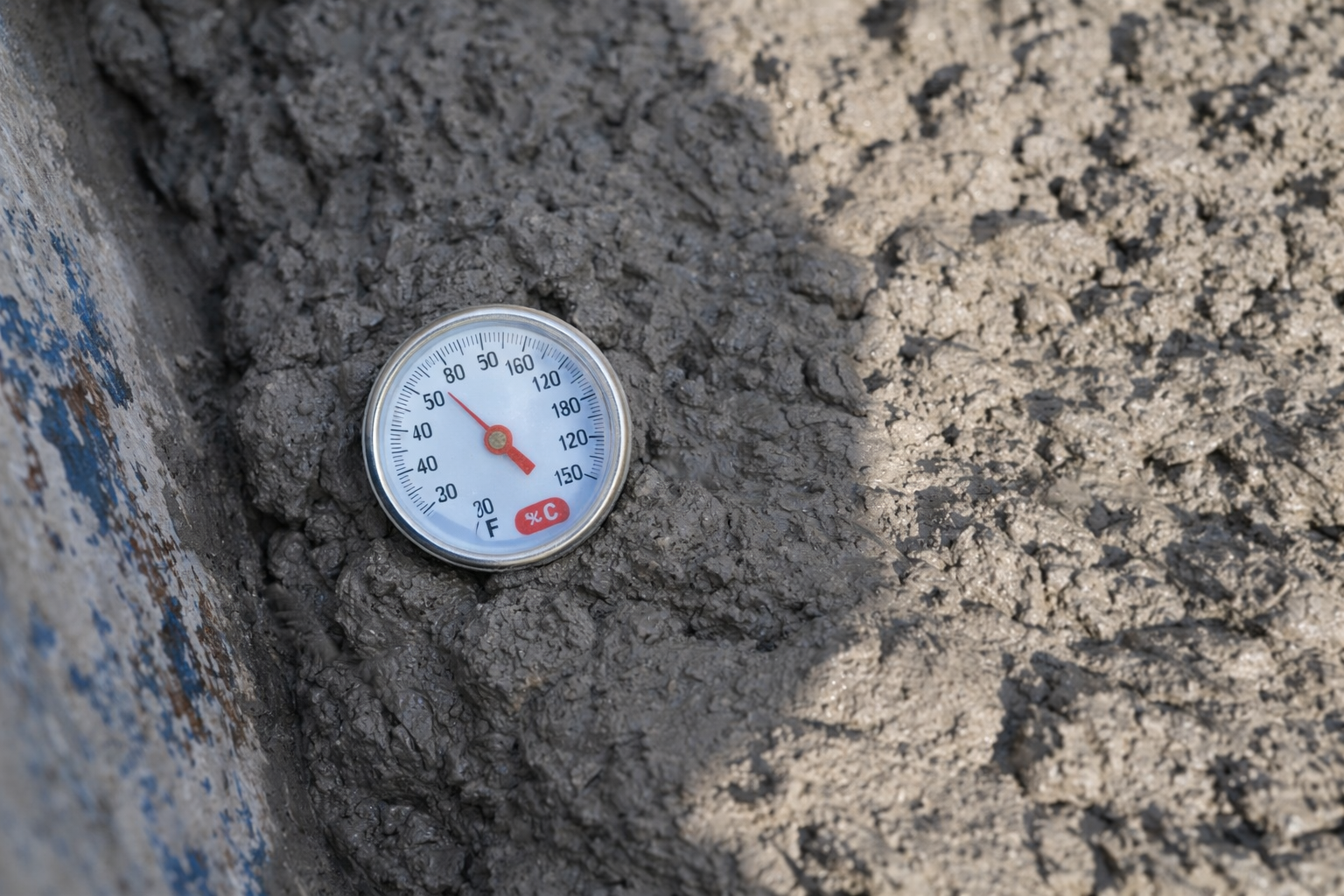
Accurate concrete temperature measurement is a critical early step in the fresh concrete field testing workflow. After a representative sample has been obtained, verifying its temperature helps identify potential risks related to curing, hydration, and environmental exposure before additional field tests are performed.
Temperature influences how concrete sets, gains strength, and ultimately performs in service. For field technicians and inspectors, measuring temperature consistently and in accordance with ASTM standards helps reduce variability and supports reliable documentation of site conditions at the time of placement.
This post focuses on Step 2 in the field testing process: measuring concrete temperature in accordance with ASTM C1064/C1064M.
ASTM Reference
C1064/C1064M
Materials Required
- Small shovel
- Non-absorbent container
- Verified thermometer
Procedure
You will need to complete this test within five minutes of collecting your sample.
Make sure your thermometer reads to the nearest 1° F (or 0.5° C) and has a range of at least 30° F to 120° F (0° C to 50° C).
While it is acceptable to measure the temperature of the concrete in the delivery vehicle or in the forms, temperature measurement is usually performed in the sample that is collected for other field tests like slump, density, and air entrainment. Collect your concrete sample according to ASTM C172/C172M and place it into the non-absorbent container. Insert your thermometer into the concrete, ensuring at least three inches of concrete surrounds the thermometer. Press the concrete around the thermometer to close any void left after insertion.
For accurate results, wait at least two minutes, but not more than five minutes before taking the reading. Leave the thermometer inserted in the concrete while reading the temperature.
ASTM C94/C94M, “Standard Specification for Ready-Mixed Concrete,” provides minimum temperatures based on the placed concrete section size, and ACI 306R provides guidance on cold weather concreting. ASTM C94/C94M and ACI 301 and 305.1 also provide limits of 90° F to 95° F in hot weather conditions. This guide and ASTM C1064/C1064M are intended to guide the technician on proper temperature measurement. They are not intended to determine acceptance of the delivered concrete.
If the measured concrete temperature is below 50°F: Risk of early-age freezing, extended set times, cold joints, insufficient early strength for load transfer.
If the measured concrete temperature is above 90°F: Rapid slump loss, increased water demand, thermal cracking, reduced ultimate strength, cold joint risk from accelerated set.
Ensure ambient air or factors like direct sunlight aren’t affecting the reading. Clean your thermometer each time.
Forney Fact
You must use a calibrated thermometer or it could lead to:
- Poor mix design – leading to weak or cracked concrete;
- Reduced concrete strength – durability concerns and a slow or fast setting (fast setting causes more heat and there is a risk of cold joints or premature drying, while a slow setting needs constant moisture);
- Project delays – the project could be halted because the concrete won’t meet specifications, violating ASTM/AASHTO standards or applicable building codes.
With temperature verified and documented, the next step in the field testing workflow is conducting a concrete slump test.