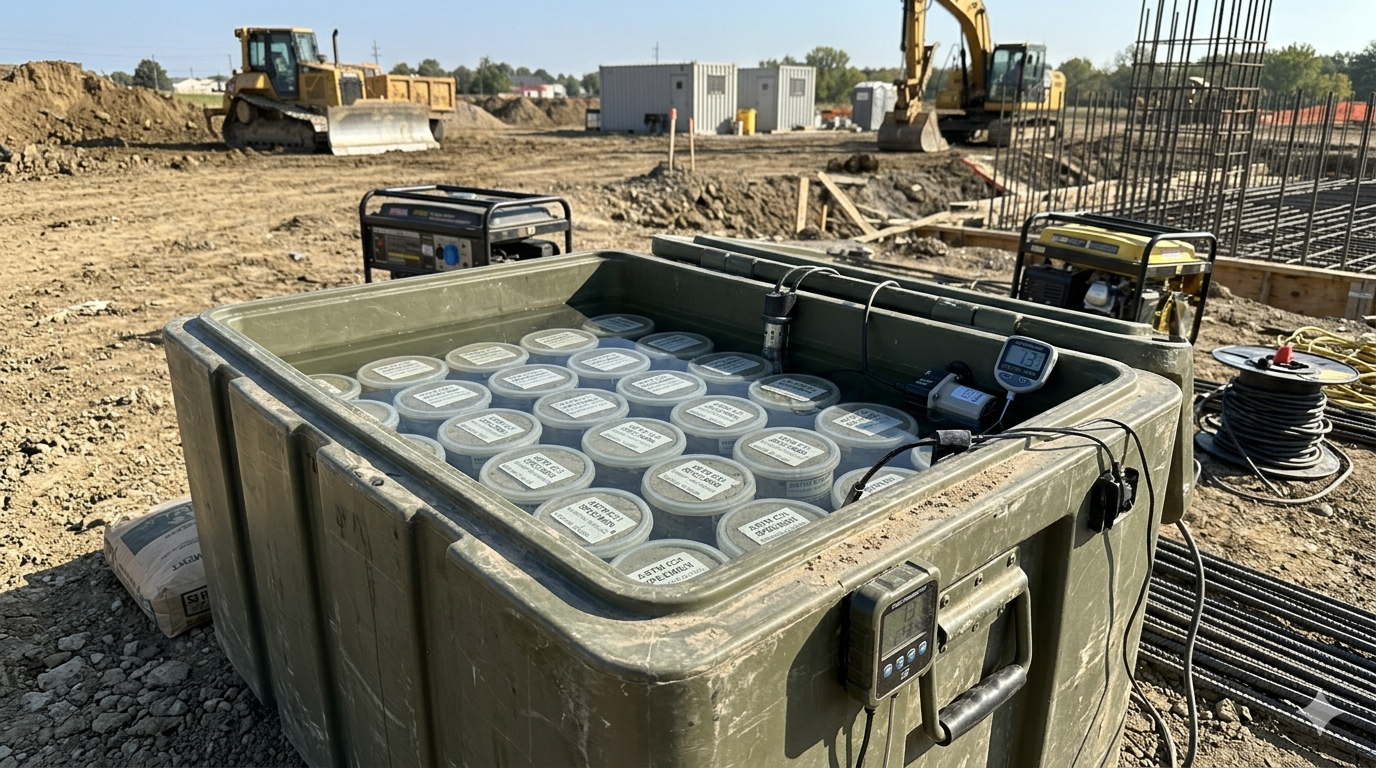
After concrete cylinders are cast in the field, the next step in the workflow is ensuring they are properly cured during the initial curing period. Initial curing is one of the most overlooked variables in concrete testing, yet it can have a significant impact on compressive strength results.
Concrete test cylinders are intended to represent the concrete delivered by the ready mix producer for the project. Improper temperature control, vibration, moisture loss, or rough handling during the first 24–48 hours can alter the curing environment and influence test results. Industry organizations including NRMCA and the Concrete Testing Adherence Collaboration (CTAC) continue to emphasize that reliable testing practices begin long before a cylinder reaches the compression machine. Proper curing is a critical link in that chain.
This guide focuses on standard-cured cylinders, which are used for acceptance testing and transported to a laboratory after initial curing. Field-cured cylinders serve a different purpose and are commonly used to estimate in-place strength for construction decisions such as form removal or post-tensioning timing.
ASTM Reference
ASTM C31/C31M
Materials Required
- 4 × 8 in. or 6 × 12 in. cylinder molds with lids or protective covers
- Initial curing box, insulated curing setup, or temperature-controlled enclosure
- Temperature monitoring device
- Cylinder transport rack or secure storage method
- Personal protective equipment for working with fresh concrete
Initial Curing Considerations
Standard-cured cylinders remain at the project site during the initial curing period before being transported to the laboratory. During this time, specimens should remain protected from environmental conditions that could affect hydration and early strength development.
Cylinders should be stored in an environment that minimizes:
- Direct sunlight
- Moisture loss from wind or excessive heat
- Freezing conditions
- Excessive vibration or movement
- Disturbance from nearby construction activity
Cylinders should remain on a level surface where they will not roll, tip, or shift during curing and transportation.
For standard-cured specimens, ASTM C31 requires the surrounding curing environment to remain between 60°F and 80°F during the initial curing period. For concrete mixtures with a specified strength of 6,000 psi or greater, the temperature range decreases to 68°F–78°F.
These temperature limits apply to the environment surrounding the cylinders, not the concrete temperature itself. The surrounding medium may consist of air, damp sand, water, or another controlled environment. Submerging concrete cylinders in plastic molds with lids during initial curing has been shown to provide an ideal curing environment. The water used to clean other field-testing tools, such as the slump cone, air meter, scoop, and tamping rod, can be reused for this purpose.
Improper temperature exposure during initial curing can affect strength development and produce test results that do not accurately represent the delivered concrete.
Forney Fact
Failure to control the temperature of initial curing has been shown to be the primary cause of reduced strength of concrete cylinders, which leads to excessive overdesign by ready mix concrete producers to compensate for the lower results. This excessive overdesign increases costs and has negative environmental impact.
Maintaining Proper Curing Conditions
Dedicated curing boxes are commonly used to maintain controlled conditions during the initial curing period. These systems help regulate temperature and protect specimens from environmental exposure while allowing technicians to monitor conditions throughout the curing window.
Where a dedicated curing enclosure is not available, insulated coolers, thermal blankets, or temporary field setups may be used to maintain acceptable conditions. Care should be taken to avoid direct contact between specimens and ice packs or heating sources.
Temperature monitoring devices should be used whenever possible to verify conditions throughout the curing period.
Proper specimen organization is equally important. Transport racks and designated storage locations help prevent cylinders from being tipped over, relocated, or accidentally discarded before transfer to the laboratory.
Final Curing and Laboratory Transition
After initial curing is complete, specimens are transported to the testing laboratory where they continue through the curing and testing process until the required break age.
In laboratory environments, standard-cured cylinders are commonly stored in lime-saturated water tanks or humidity-controlled curing rooms designed to maintain consistent curing conditions.
Forney Fact
Proper labeling and specimen identification matter more than many people realize. A perfectly cast cylinder with poor labeling or temporary jobsite placement can easily be moved, misplaced, or discarded. Establishing a consistent identification and storage process protects the integrity of the testing workflow from the start.
Our next guide in the fresh concrete workflow series focuses on properly transporting concrete cylinders to the Lab.