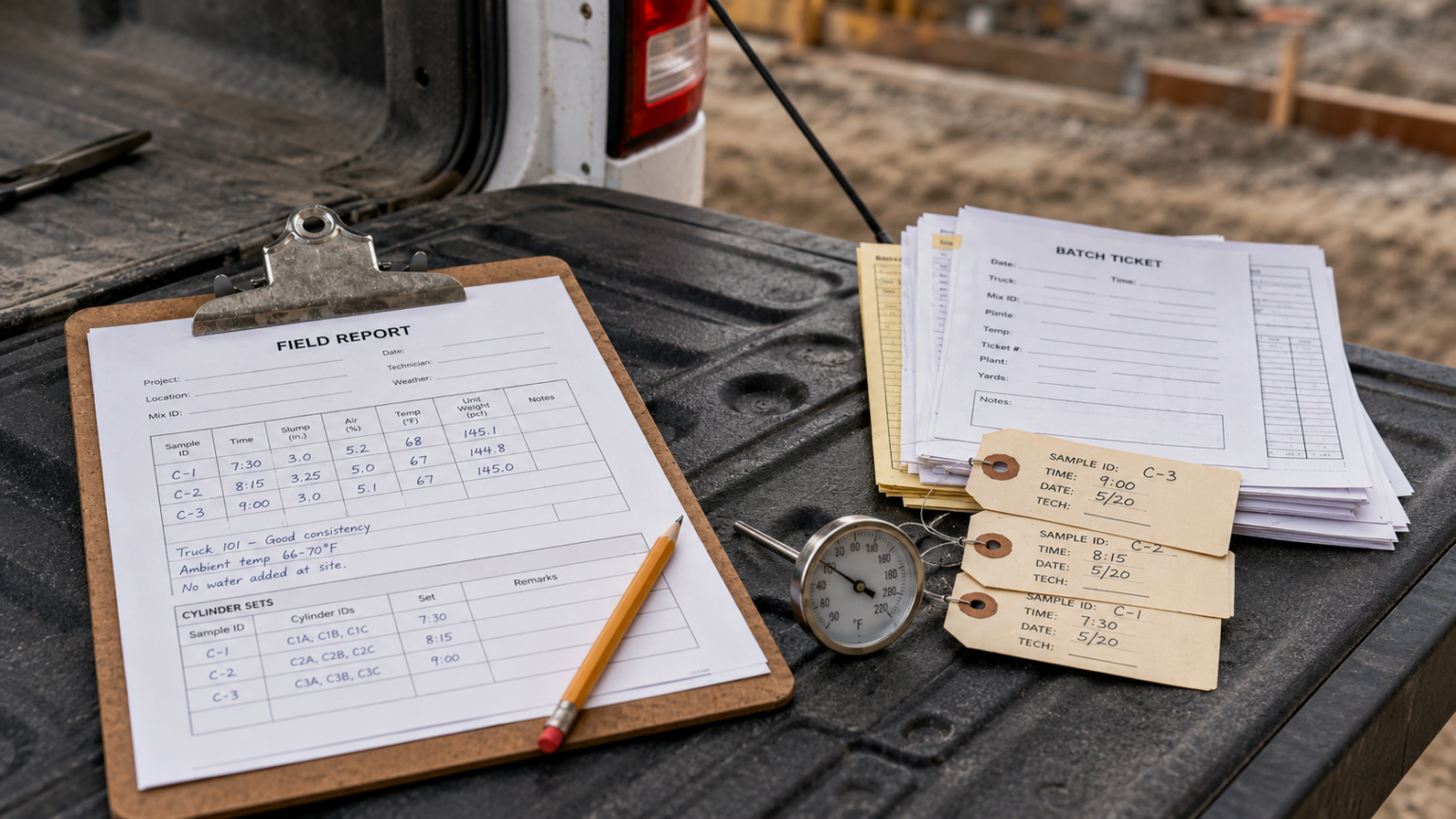
Recording and reporting is the backbone of the entire fresh concrete testing workflow. Without it, rejected concrete loads, invalid strength tests, lost dispute protection and failed audits are all on the table. While no single ASTM standard governs the full reporting process, each test in the workflow carries its own documentation requirements. Here’s a breakdown of what each standard demands.
ASTM C172 – Sampling Freshly Mixed Concrete
At the point of sampling, the technician must record the sample’s location, the concrete it represents and the time of casting. Slump, air content and temperature must all be measured and recorded within 5 minutes of obtaining the final portion of the composite sample.
ASTM C31 – Making and Curing Concrete Test Specimens in the Field
C31 carries the most extensive reporting obligations. The following must be reported to the testing laboratory with every set of specimens:
- Identification number or project number
- Location of the concrete represented
- Date, time and technician’s name
- Slump, air content and temperature results, plus any deviations from standard test methods
- For standard curing, the maximum and minimum temperatures and final curing method. For field curing, the storage location, environmental protection method, temperature and moisture conditions and time of mold removal
- Specimen marking that positively identifies each specimen without altering the concrete surface. The mark cannot be placed on the removable cap. If the mark is wrong, illegible or placed incorrectly, the entire test result becomes legally questionable. Connecting a physical cylinder to its field record is key.
- Any deviations from casting or curing procedures must be documented on the report
ForneyFact
Per ASTM C94, deviations in initial curing temperature can reduce strength results by up to 25% and may invalidate cylinders for acceptance testing.
ASTM C1064 – Temperature of Freshly Mixed Hydraulic-Cement Concrete
Report the concrete temperature to the nearest 1°F [0.5°C].
ForneyFact
Beyond the field reading, the standard requires a traceable equipment documentation chain. Field devices must be calibrated annually and the reference device used to verify them must be accurate to ±0.5°F [0.2°C] and carry a certificate traceable to The National Institute of Standards and Technology (NIST).
ASTM C143 – Slump of Hydraulic-Cement Concrete
Report slump to the nearest ¼ in. [5 mm].
ForneyFact
Every slump cone must have a dimension check on file at purchase and at least annually thereafter.
ASTM C231 – Air Content of Freshly Mixed Concrete (Pressure Method)
Report air content to the nearest 0.1% after applying the aggregate correction factor (ACF). The aggregate correction factor is not a fixed number pulled from a table. It must be determined from testing the actual fine and coarse aggregates in the mix. If the mix design changes, the ACF changes. That makes it a test-derived value that must be documented on file per mix design, not just per meter.
The standard also requires a permanent calibration log, not just a one-time certificate, documenting the expansion factor, calibration vessel size and meter readings at each calibration point. Calibration must occur at least every three months.
ForneyFact
Type A meters have an additional field requirement. They must be recalibrated any time they move more than 600 feet in elevation. Type A meters use barometric pressure as part of their measurement principle, so a significant change in altitude changes the test.
ASTM C173 – Air Content of Freshly Mixed Concrete (Volumetric Method)
Report air content to the nearest 0.25%. The reading is only valid when the liquid level stabilizes, defined as no change greater than 0.25% within a 2-minute window. If stabilization takes more than 6 minutes, the test is invalid. For concrete with air content above 9%, calibrated cups of water are added and the number of cups must be recorded and factored into the final result.
After completing the test, the meter must be disassembled and inspected. If mortar is found adhering to the inside of the measuring bowl, the test must be discarded.
The meter and calibrated cup must be calibrated at purchase and annually, or whenever there is reason to suspect damage or deformation. If any foam-suppressing agent other than standard 70% isopropyl alcohol is used, documentation of that agent’s testing or correction factors must be kept on file in the laboratory.
ASTM C138 – Density (Unit Weight), Yield, and Air Content (Gravimetric) of Concrete
C138 has the most structured report section of any fresh concrete test standard. Required fields include:
- Concrete identification
- Date of test
- Volume of the density measure
- Density (unit weight)
- Theoretical density, if requested
Because yield, cement content and gravimetric air content are all calculated and not directly read, the batched quantities of every mix ingredient must also be on record to complete those calculations.
This data does not come from the field, but rather the producer’s batch ticket. Field records and plant records must be matched and preserved together.
ForneyFact
The density measure must be calibrated per C29/C29M; the internal vibrator frequency must be verified at least every two years; and the balance must be accurate to within 0.3% across its full range of use.
ASTM C1077 – Standard Practice for Agencies Testing Concrete and Concrete Aggregates for Use in Construction and Criteria for Testing Agency Evaluation
C1077 is the lab accreditation standard that frames why all of this field documentation ultimately has to flow into a compliant lab-level system. It requires that test reports include:
- The laboratory’s name and address
- The client’s name, project and sample identifications
- The name of the supervising Professional Engineer
Labs must retain all test reports for a minimum of three years. C1077 also requires a written quality manual, ongoing personnel training and evaluation and participation in proficiency sample programs.
The Importance of Accurate Recording and Reporting
Accurate recording and reporting are what connect the entire fresh concrete field testing workflow. Each field test produces required data, but that data only becomes useful when it is properly documented, tied to the correct sample or specimen, and preserved with the supporting project, technician, equipment, and batch information. From sampling and temperature to slump, air content, density, curing conditions, and lab-level reporting requirements, the standards reinforce the same principle: reliable concrete testing depends on complete, traceable records.
In the next guide, we will look at how digital field data collection can help streamline this process. Guide 10 will focus on how ForneyField and ForneyVault connect field testing, sample creation, specimen tracking, laboratory testing and client-facing reporting into a more efficient, organized, and auditable workflow.