
Our Fresh Concrete Field Testing series followed concrete from sampling through casting, initial curing and transport to the laboratory. This series continues that workflow, starting with specimen receipt and following the steps that lead to reliable strength results and complete reports.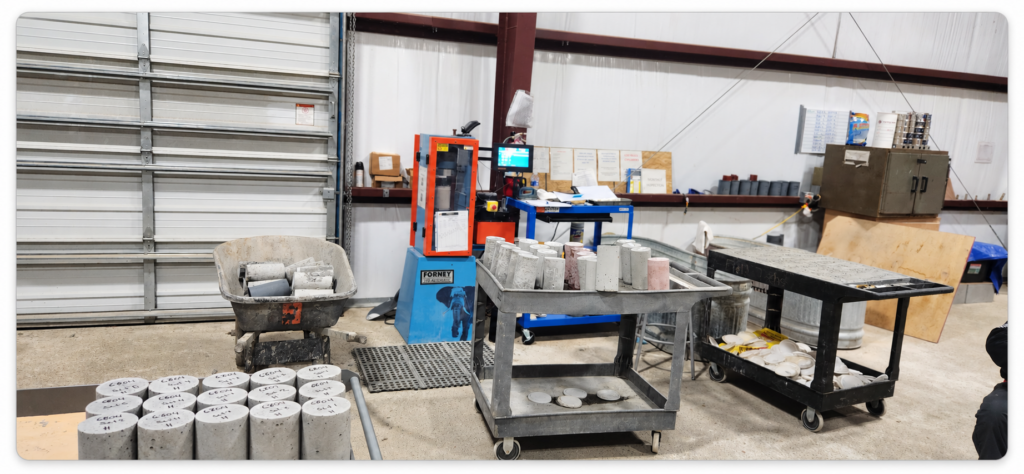
At check-in, the lab confirms that the specimens received match the field records, documents their condition and preserves the connection between each specimen and the concrete it represents. This guide focuses on standard-cured concrete cylinders. Specimens designated for field curing require handling consistent with their intended purpose and the applicable procedures.
ASTM References
- ASTM C31/C31M — Making and curing concrete test specimens in the field, including transportation and laboratory curing.
- ASTM C1077 — Requirements for concrete testing agencies, personnel, equipment and records.
- ASTM C511 — Requirements for moist rooms and water storage tanks used for curing.
Use the standards editions required by the project and the laboratory’s approved procedures. The receiving practices below combine standards-related checks with practical ways to maintain identification and traceability.
Materials Required
- Field records and the expected specimen list
- Receiving log or digital specimen tracking system
- Durable marking supplies and curing-compatible labels
- Barcode scanner and label printer, if used
- Camera or device for documenting condition
- Appropriate handling PPE and access to the designated curing area
Prepare for Specimen Arrival
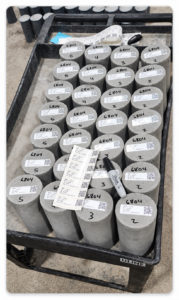 Review the expected deliveries, including projects, placement locations, specimen counts and requested test ages. Have the receiving system ready and confirm that curing space is available under the required conditions.
Plan the handoff to demolding and final curing before specimens arrive. For standard-cured cylinders, C31/C31M specifies final curing upon completion of initial curing and within 30 minutes after mold removal. Check-in should support that sequence without creating unnecessary delays.
Inspect Incoming Conditions
Compare the delivery with the field record and document what can be observed at receipt. Inspect the molds and exposed surfaces; complete the specimen inspection during demolding. Photograph visible damage or unusual conditions.
- Timing. Record casting and receipt dates and times. Review the initial curing duration against the applicable requirements, including the provision for initial curing up to 48 hours after molding.
- Initial curing history. Review recorded maximum and minimum temperatures of the surrounding curing environment: 60–80°F (16–27°C), or 68–78°F (20–26°C) for concrete with a specified strength of 6,000 psi or greater. A temperature reading at arrival does not establish the earlier curing history.
- Transport. Confirm the recorded transport duration, which must not exceed four hours, and note reported impacts, loss of moisture or possible freezing exposure.
- Molds and exposed surfaces. Check for damaged or distorted molds, loose or missing covers, visible cracks, chipped edges and signs of drying. Note surfaces that remain concealed until demolding.
- Quantity and identification. Compare the number of specimens and their existing IDs with the delivery record. Record missing, extra, unreadable or mismatched specimens.
Verify the Documentation
Confirm the specimen identification, the location of the concrete represented, casting date and time, technician’s name, fresh concrete test results, curing history and reported deviations. Also check project-specific information such as mix and batch ticket references, specimen sizes and requested test ages.
Add the receipt date and time, receiving technician and condition findings to the lab record. Our field recording and reporting guide explains the documentation that accompanies specimens from the jobsite.
Preserve Identification Through Demolding
Identification begins in the field. At receipt, verify each existing ID and retain its connection to the original sample and project record. If the lab assigns an internal number, preserve the mapping to the field identification.
While a specimen remains in its mold, keep the mold identification legible and linked to the receiving record. During demolding, transfer or confirm durable identification on the exposed specimen before discarding the mold or setting the specimen aside. Work in a controlled sequence to prevent mix-ups.
Use markings or labels suitable for moist curing, positioned on the side of the cylinder where they will not interfere with end preparation or testing. A barcode can simplify identification, but it still needs to remain readable and connected to the correct record.
Document and Escalate Discrepancies
Missing paperwork, uncertain identification or visible damage should trigger a documented review under the lab’s procedures. Preserve the existing identification, describe the issue and notify the laboratory supervisor and appropriate project contact. Maintain the required protection and curing conditions while the discrepancy is investigated.
Receiving staff should not guess at an identity or independently decide that a questionable specimen is suitable for acceptance testing. Record who reviewed the issue and the authorized disposition, including any reporting qualification. Additional sampling or core testing requires an appropriate project-level decision; newly cast specimens cannot recreate the original sample.
Connect Each Specimen to Its Scheduled Test
Traceability connects the project, placement, concrete sample, individual specimen, scheduled test and result. At check-in, verify the requested test ages and existing schedule. Where scheduling is incomplete, establish it through the lab’s procedures using the recorded casting date and time, rather than the receipt date.
Paper logs and spreadsheets can maintain these connections, but repeated transcription adds work and creates opportunities for error. A connected workflow allows field information to remain associated with specimens as they move through the laboratory.
With ForneyField® and ForneyVault®, field records and specimen identification can remain connected to lab testing and reporting. Results from a ForneyVault-compatible testing machine return to the associated specimen record. Barcode identification can help staff retrieve the correct record without retyping specimen information.
Forney Fact
A specimen ID is more than a label. It is the connection between the concrete sampled in the field and the strength result reported by the laboratory. Preserve that connection through every handoff, including mold removal.
Next in the Series
Demolding Concrete Cylinders: Timing, Handling and Transfer to Standard Curing continues the workflow, covering mold removal, specimen inspection and the move into final curing.
Have a question about your lab’s workflow? Visit the Forney Knowledge Base or talk to our team.